Overview
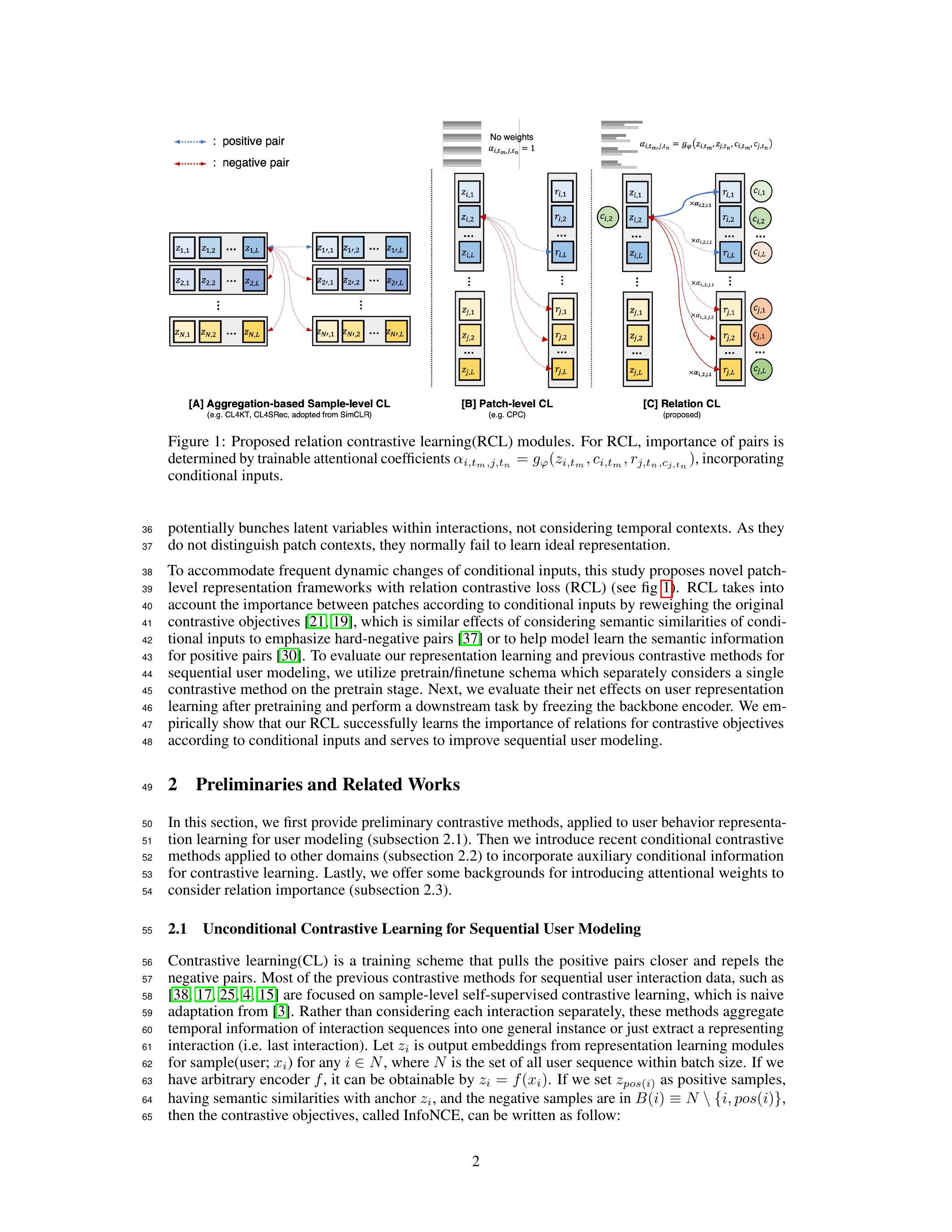
At RIIID (뤼이드), proposed Attentive Conditional Contrastive Learning (ACCL) and Relation Contrastive Learning (RCL), achieving state-of-the-art on student (user) modeling—including dropout prediction, conditional dropout prediction, and knowledge tracing—across 6 benchmarks. Deployed to the Santa TOEIC platform.
Key Achievements
- SOTA on Student Modeling: Achieved state-of-the-art on dropout prediction, conditional dropout prediction, and knowledge tracing with proposed ACCL across multiple benchmarks
- Multi-Dataset Validation: Validated approach across 6 different datasets
- Production Deployment: Deployed to Santa TOEIC app via BentoML
- Novel Methods: ACCL (trainable attentional coefficients reweighting CL objectives) and RCL (RelationNCE loss)
Technical Approach
Dropout Prediction
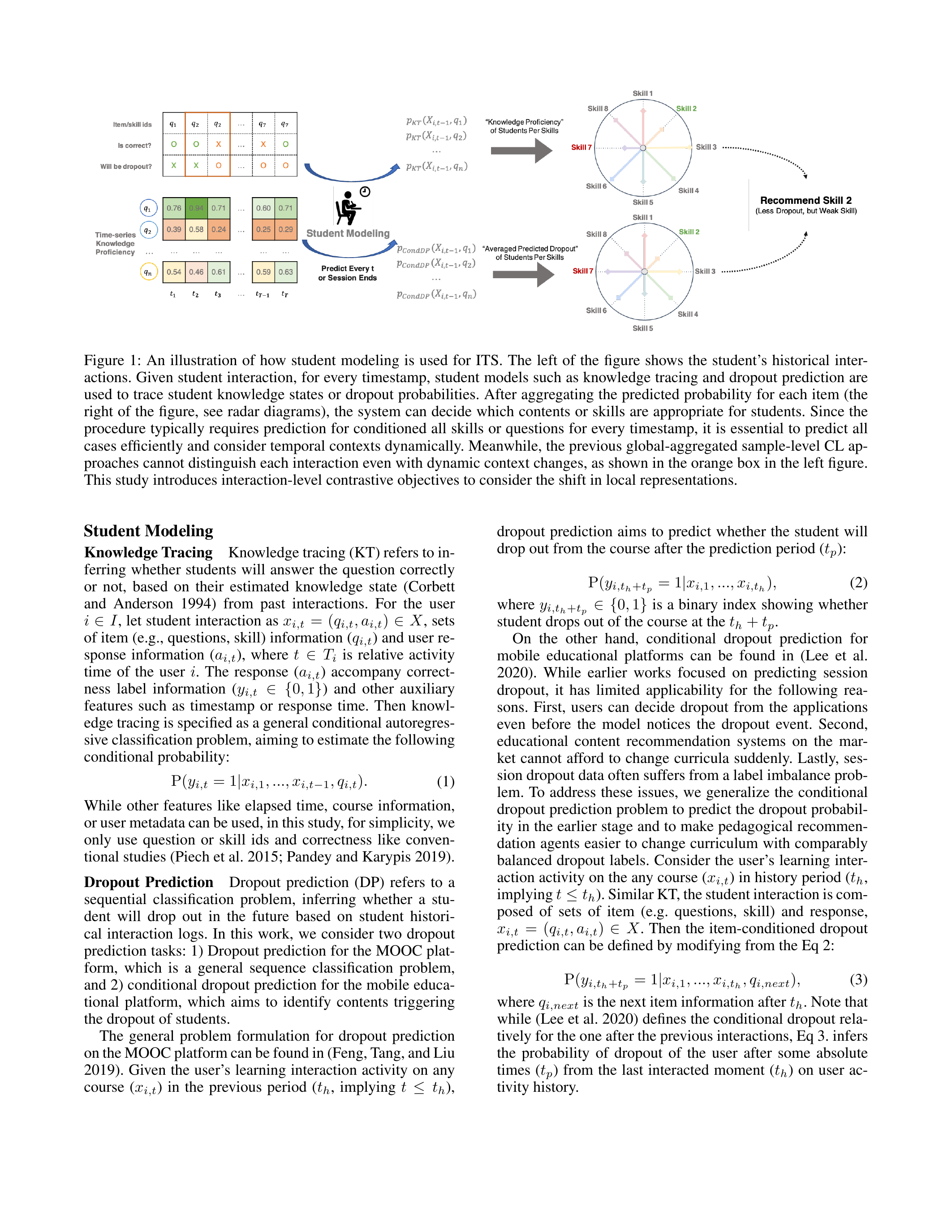
Predicting whether a student will churn from the learning platform, enabling early intervention strategies. Covers both naive dropout prediction and conditional dropout prediction (conditioned on contextual information). Achieved SOTA with the proposed ACCL method.
Knowledge Tracing
Predicting whether a student will correctly answer a question based on their historical interaction patterns. Improved performance with contrastive learning approaches.
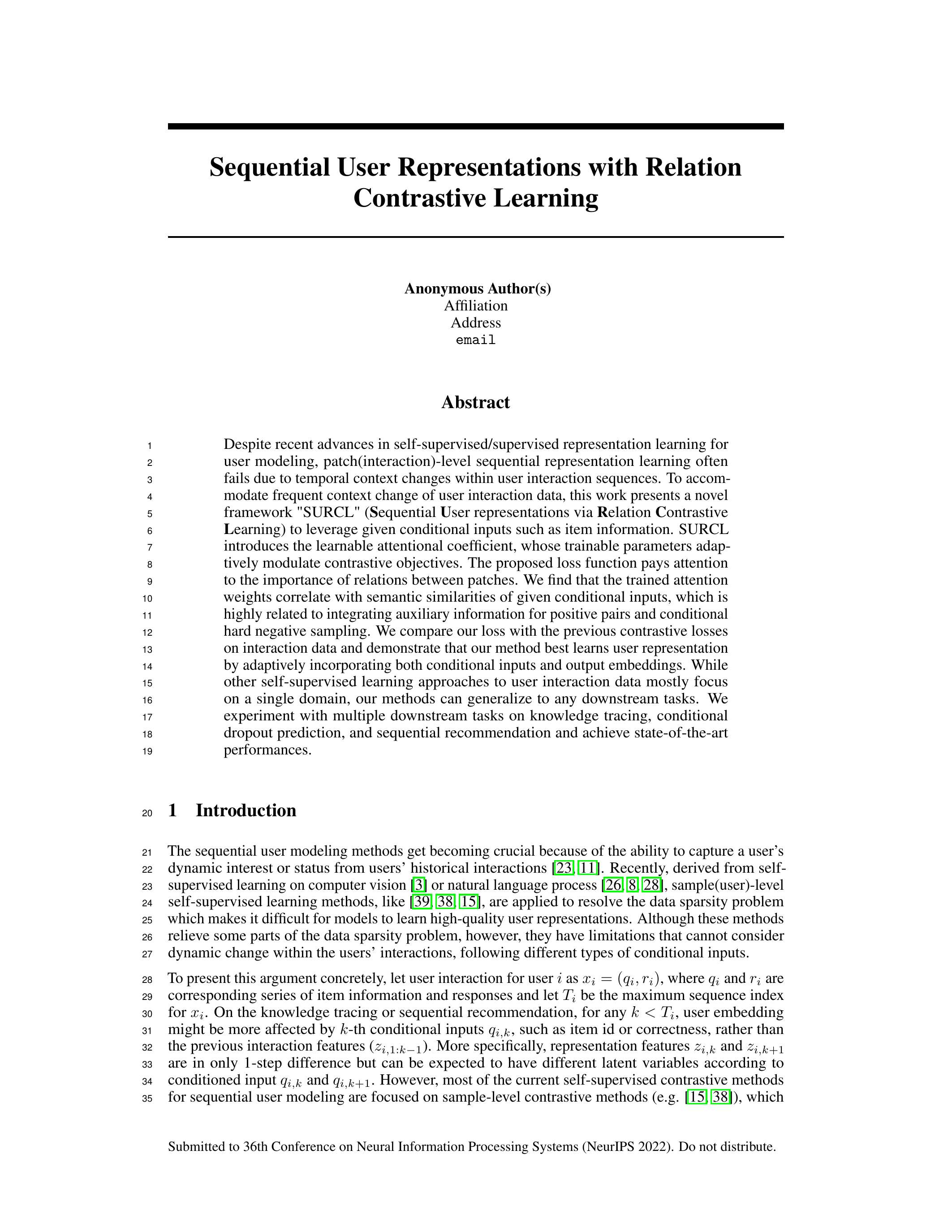
SAICL: Auxiliary Interaction-level Contrastive Learning
The SAICL framework introduces a novel student modeling approach that addresses the sparsity problem in user interaction sequences by:
- Self-supervised contrastive objective at each interaction step (not just sequence-level)
- Auxiliary interaction-level CL that helps the model distinguish between user behavior dynamics across sessions
- Conditional dropout prediction (CondDP) — a new task formulation beyond standard knowledge tracing
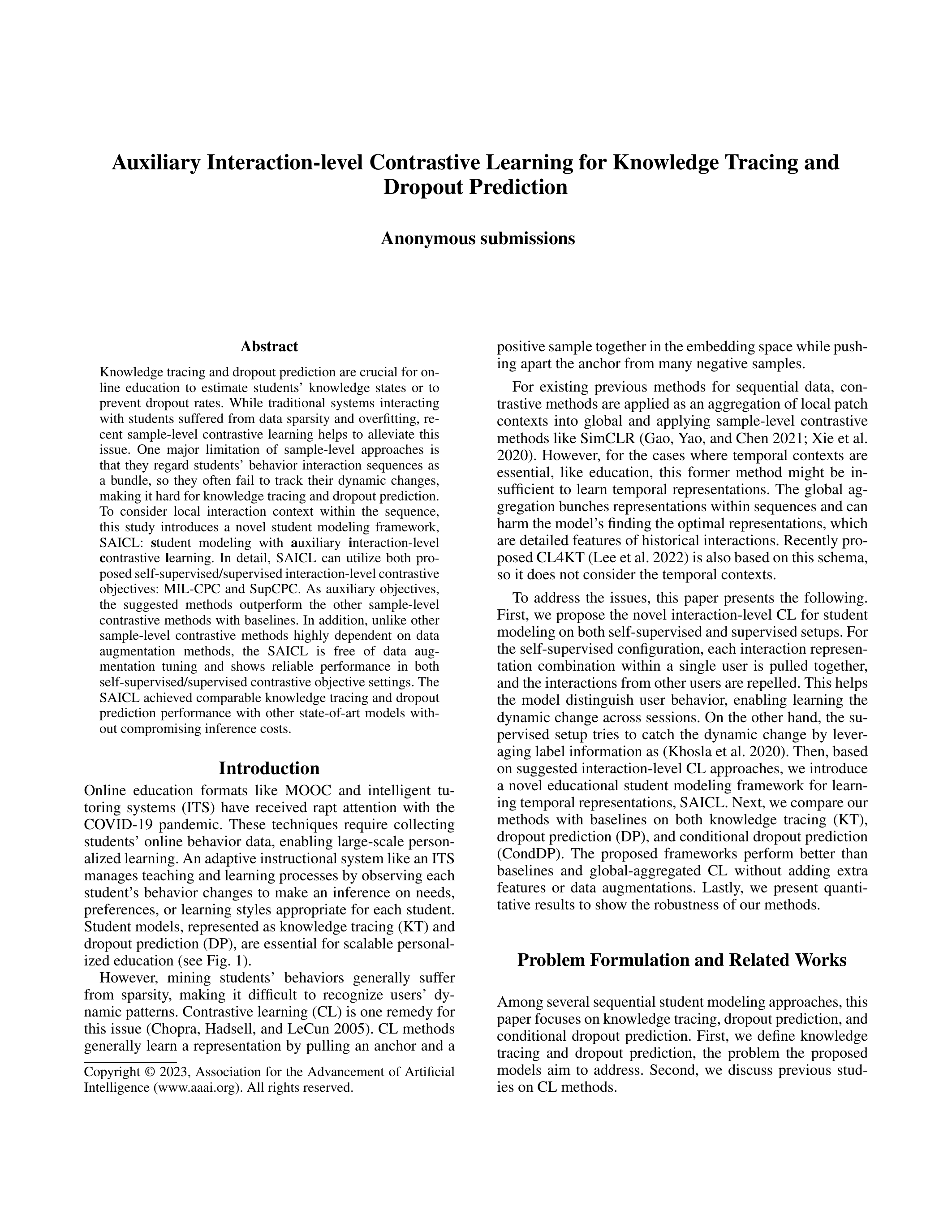
SURCL: Sequential User Representations via Relation Contrastive Learning
SURCL introduces learnable attentional coefficients for RelationNCE loss that:
- Pay attention to relations between patches rather than just point-level contrasts
- Adaptively mediate contrastive objectives based on conditional input similarity
- Incorporate both conditional inputs and output embeddings for better user representations
- Generalize across multiple downstream tasks (knowledge tracing, dropout prediction, sequential recommendation)
Tech Stack
- Framework: PyTorch
- Architecture: Transformer, Sequential Modeling
- Method: Contrastive Learning, Knowledge Tracing
- Deployment: BentoML
Period
August 2021 - October 2022
Impact
Better understanding of student learning patterns enables personalized learning recommendations, early intervention for struggling students, and improved content difficulty calibration on the Santa TOEIC platform.
Publications
- Jungbae Park, Jinyoung Kim, Soonwoo Kwon, Sang Wan Lee - “SAICL: Auxiliary Interaction-level Contrastive Learning for Knowledge Tracing and Dropout Prediction” (Submitted to AAAI 2023; arXiv:2210.09012)
- Jungbae Park, Soonwoo Kwon, Jinyoung Kim, Sang Wan Lee - “SURCL: Sequential User Representations via Relation Contrastive Learning” (Submitted to NeurIPS 2022)