
Overview
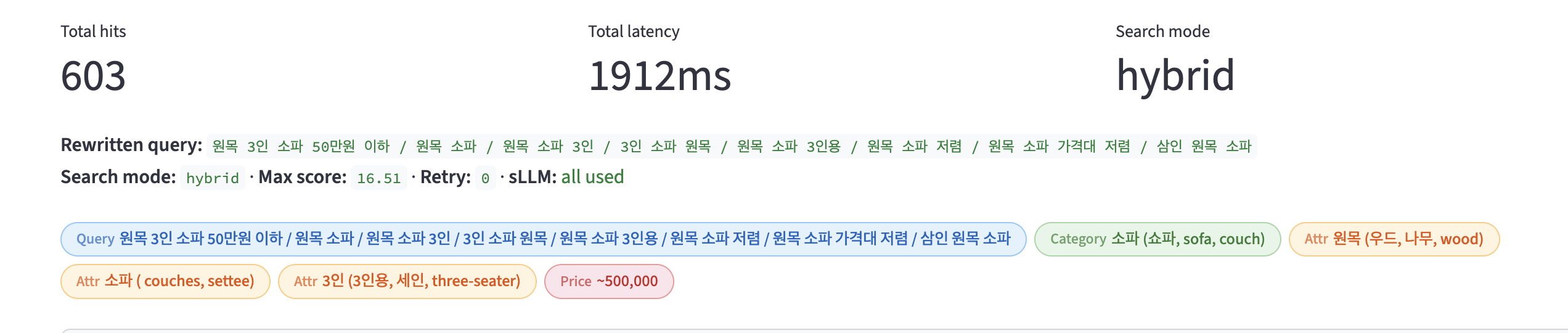
At Bucketplace (오늘의집), I am building an AI-powered search agent that interprets natural language queries and translates them into structured retrieval signals for Room Planner 3D products. The system decomposes free-form user intent into actionable dimensions – category, attributes, color, dimensions, and budget – via LLM reasoning, then executes BM25+KNN hybrid search on ElasticSearch to surface the most relevant 3D product models.
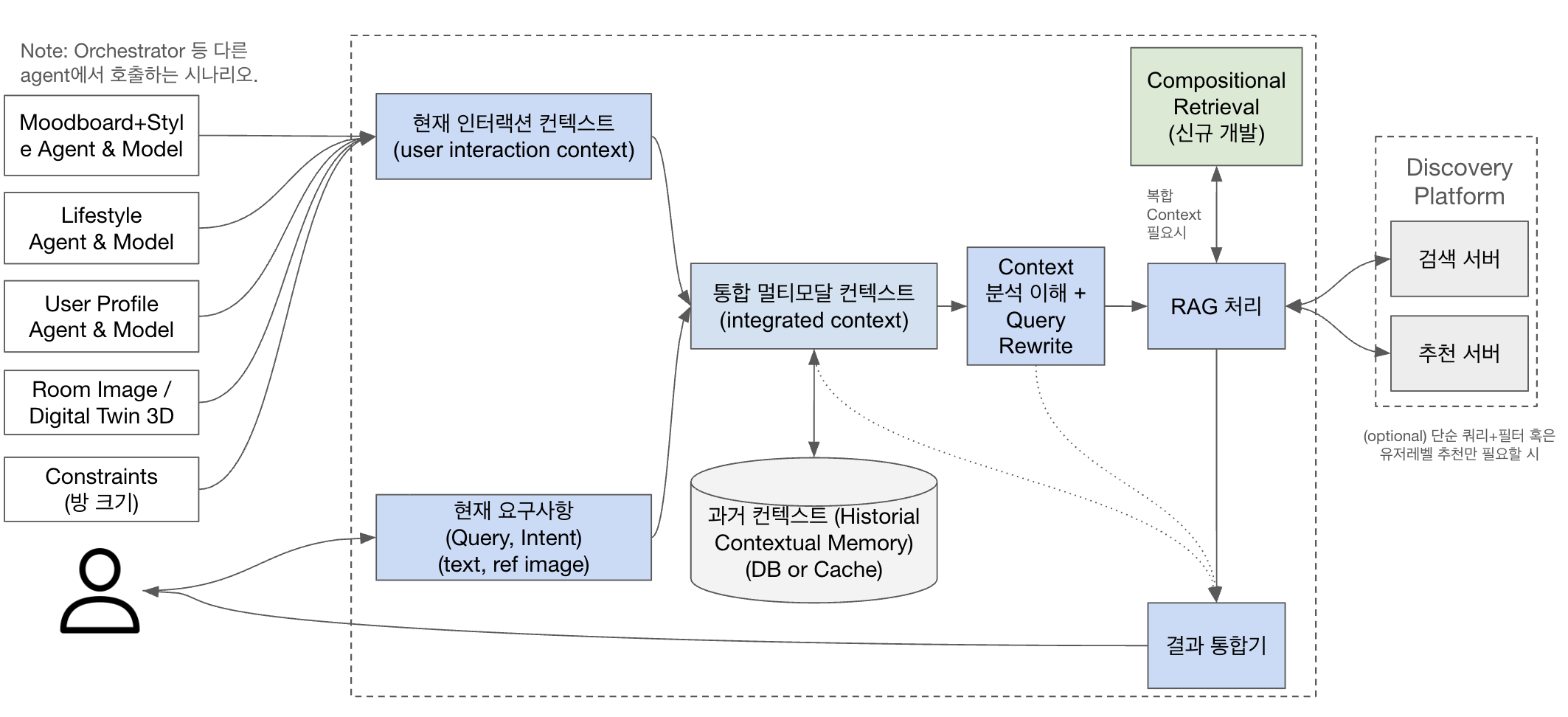
At the core of this project is CoI-Fit (Context-Intent Fit Matching), a compositional multimodal retrieval framework I designed to serve as the retrieval backbone for multiple downstream agents. CoI-Fit combines space analysis, mood/style interpretation, dimensional constraints, and conversational context drawn from image, text, and 3D coordinate inputs to produce contextually grounded retrieval results.
Key Achievements
- Compositional Retrieval Framework: Designed CoI-Fit, a novel multimodal retrieval architecture that fuses heterogeneous signals (visual, textual, spatial) into a unified retrieval pipeline
- Two-Tier Negative Query Separation: Hard exclude (must-not) + soft downrank via graduated confidence scoring, preventing irrelevant results while preserving recall
- 5-Level Progressive Fallback: Graceful degradation from full-signal retrieval down to broad category search, ensuring non-empty results even for ambiguous queries
- Multi-Agent Architecture: Architected a LangGraph pipeline with parallel fan-out inference, enabling concurrent processing of multiple retrieval dimensions
- Dual Interface Design: Built both A2A (Agent-to-Agent) JSON-RPC and REST/FastAPI interfaces, enabling seamless integration with both agent ecosystems and traditional service architectures
- Auto Quality Recovery: Implemented intelligent filter relaxation retry mechanisms that automatically recover from overly restrictive queries, ensuring high recall even for long-tail searches
- Automated Quality Evaluation: 8-dimension rule-based CI scoring + LLM-as-Judge with LangFuse experiment tracking; persona-based synthetic query generation for long-tail coverage
Benchmark Results (634 queries)
| Metric | Improvement |
|---|---|
| Judge Satisfaction | +11.9% |
| Category Recall | +16.6% |
| Positive Hit | +18.0% |
| Negative Leak | -50% |
| Latency p50 | -20.8% |
graph LR
    A[NL Query] --> B[LLM Parse]
    B --> C[Negative\nSeparation]
    C --> D[BM25+KNN\nHybrid Search]
    D --> E[Graduated\nConfidence Scoring]
    E --> F[5-Level\nFallback]
    F --> G[Ranked Results]
Technical Approach
Pipeline Topology
The system follows a multi-stage agentic pipeline with parallel fan-out for inference:
flowchart TD
    A[preprocess] --> B1[pre_analyze]
    A --> B2[pre_category_agg]
    B1 --> C[planner]
    B2 --> C
    C --> D1[query_rewrite]
    C --> D2[query_embedding]
    C --> D3[infer_category]
    C --> D4[infer_attributes]
    C --> D5[infer_colors]
    C --> D6[infer_price]
    C --> D7[infer_dimensions]
    C --> D8[negative_separation]
    D1 --> E[retrieve_with_signals]
    D2 --> E
    D3 --> E
    D4 --> E
    D5 --> E
    D6 --> E
    D7 --> E
    D8 --> E
    E --> F[twidder]
    F --> G[confidence_scoring]
    G --> H[check_refine]
    H -->|retry\n5-level fallback| E
    H -->|final| I[format_response]
Request Journey (End-to-End)
- Intake: Input normalization, safety check, format validation
- Analyze & Plan: Language/token analysis, category aggregation, search mode determination
- Parallel Intelligence: Fan-out to 8 concurrent inference nodes — query rewrite, embedding generation, category/attribute/color/price/dimension signal extraction, and negative query separation (hard exclude vs. soft downrank)
- Retrieval & Ranking: BM25 + KNN hybrid search with two-tier negative filtering and twidder for product_id deduplication
- Confidence Scoring: Graduated scoring across retrieval signals to rank results by match quality
- Quality Recovery: 5-level progressive fallback (full-signal → relaxed filters → broad category) with max 1 refine to protect p99
- Response: Final items with optional debug metadata (node latency, signals, ES query)
CoI-Fit: Compositional Multimodal Retrieval
CoI-Fit (Context-Intent Fit Matching) serves as the retrieval backbone for multiple downstream agents:
- Space Analysis: Understanding room context and spatial arrangement from 3D coordinates
- Mood/Style Matching: Extracting aesthetic intent from text and image inputs
- Dimensional Constraints: Filtering by physical size requirements derived from the 3D scene
- Conversational Context: Maintaining coherent retrieval across multi-turn interactions
State Design (3-Layer)
| Layer | Role | Properties |
|---|---|---|
inputs | Request original | Immutable |
artifacts | Intermediate outputs | Mutable, parallel accumulation |
outputs | Final response | Finalized at exit |
Architecture Integration
The system operates as both a standalone service and a domain agent within the AI-AP (AI Agent Platform) orchestrator:
- Standalone: Direct REST/A2A calls for search queries
- Orchestrated: AI-AP Orchestrator routes search requests via agent capability discovery
- Clear boundary: Orchestrator handles control plane (routing, fallback, circuit break); search agent handles execution plane (BM25/KNN, signal inference, ranking)
Tech Stack
- Agent Framework: LangGraph, A2A (Agent-to-Agent Protocol), ADK (Agent Development Kit)
- Observability: LangFuse
- Search Infrastructure: ElasticSearch (BM25 + KNN hybrid, blue/green index deployment)
- Embedding Models: SigLIP2, QWEN-3-VL-Embedding-2B (composed text+image embedding)
- Orchestration: Airflow (batch indexing), K8S Operator
- Model Serving: Triton Inference Server
- API: FastAPI, JSON-RPC 2.0
- Evaluation: Persona-based synthetic query generation + LLM-as-Judge
Future Work
- CoI-Fit Phase 2: Multi-vector search with
intent vector + context vector + preference vectorfor conversational queries - Content Mixing: Blending product results with review/style content for answer-type exploration
- Personalization: Injecting user behavior features (click/scrap/purchase/dwell) into retrieval/rerank stages
Impact
This project establishes a foundational retrieval layer for the Room Planner ecosystem at Bucketplace. By serving as the retrieval backbone for multiple downstream agents, CoI-Fit enables a new class of AI-powered interior design experiences where users can describe what they want in natural language – referencing images, spatial constraints, and stylistic preferences – and receive precisely matched 3D product recommendations. The dual A2A/REST interface ensures the system integrates cleanly into both the emerging agent-to-agent ecosystem and existing microservice infrastructure.
Period
January 2026 - Current | Bucketplace (오늘의집)